Hey there! I’m working for a supplier of other auxiliary equipment, and I’m super excited to have a chat with you about how our gear plays a huge role in data collection and analysis during production. Other Auxiliary Equipment

Let’s kick things off by understanding why data collection and analysis matter so much in production. In today’s competitive world, manufacturers are always looking for ways to boost efficiency, improve quality, and cut costs. And that’s where data comes in. By collecting and analyzing data, companies can make smarter decisions, spot problems early, and optimize their production processes.
But collecting and analyzing data isn’t as easy as it sounds. You need the right tools and equipment to get accurate and reliable data. That’s where our other auxiliary equipment steps in. We’ve got a wide range of products that can help you collect, process, and analyze data in real – time.
First up, let’s talk about sensors. Sensors are like the eyes and ears of your production line. They can measure all sorts of things, like temperature, pressure, humidity, vibration, and more. For example, in a manufacturing plant that produces metal parts, temperature sensors can be placed on the machines. If the temperature gets too high, it could indicate that the machine is overheating, which might lead to breakdowns or poor – quality parts. By collecting temperature data regularly with these sensors, you can identify potential issues before they turn into big problems.
We offer different types of sensors to fit all kinds of production needs. There are contact sensors that need to be directly in touch with the object being measured, and non – contact sensors that can measure from a distance. And the data they collect is fed into a data acquisition system.
Our data acquisition systems are the next crucial piece of the puzzle. They take the raw data from the sensors, convert it into a digital format, and store it. These systems are designed to be very reliable and can handle a large amount of data. They also have some built – in processing capabilities. For instance, they can calculate averages, maximum and minimum values, and other statistical information. Think of a food processing factory. The data acquisition system can collect data from multiple sensors on different production lines, like the weight of the products on the conveyor belts, the speed of the equipment, and the temperature in the storage areas. Then it aggregates all this data in one place, making it easier for the analysis team to access and work with.
Once the data is collected and stored, it’s time for analysis. And this is where our analytical software comes in really handy. Our software is user – friendly and doesn’t require you to be a data science expert to use it. It can perform a variety of analyses, such as trend analysis, correlation analysis, and anomaly detection.
Let’s say you’re running a chemical production plant. The analytical software can analyze the data from sensors measuring the chemical concentrations, flow rates, and reaction temperatures. It can detect trends over time, like if the production yield is gradually decreasing. It can also find correlations between different variables. Maybe it discovers that when the temperature in a certain part of the process goes up, the quality of the final product goes down. And if there’s an abnormal reading, like a sudden spike in pressure, the software can immediately alert the operators, so they can take action right away.
Another piece of equipment that helps in data – related tasks is the industrial computer. These computers are built to withstand harsh industrial environments. They can run the data acquisition systems and the analytical software smoothly. In a car manufacturing plant, for example, industrial computers can be used to manage the data collection and analysis for the assembly line. They can handle the high – speed data transfer from multiple sensors and ensure that the analysis is done in real – time.
Now, let’s look at how all this equipment works together. Imagine a textile production facility. Sensors are placed on the spinning machines to measure the tension of the yarn, the speed of the spindles, and the temperature of the motors. The data from these sensors is sent to a data acquisition system, which stores it in a database. The industrial computer then runs the analytical software on this data. The software analyzes the data to find out if there are any patterns that could lead to yarn breakage or poor – quality fabric. If it detects a potential issue, it notifies the operators, who can then adjust the machines accordingly.
We also know that in production, time is money. That’s why our equipment is designed for quick and easy installation. And we offer ongoing support to make sure you can get the most out of it. Whether you have a small workshop or a large – scale factory, our other auxiliary equipment can be customized to fit your specific needs.
If you’re still not convinced about the benefits of using our equipment for data collection and analysis during production, let me give you a couple of real – life examples. One of our customers is a small electronics manufacturer. Before using our equipment, they were having a hard time keeping up with the quality control. They had high rates of defective products, and they couldn’t figure out why. After installing our sensors on their production lines and using our analytical software, they discovered that a particular soldering machine was causing most of the defects. By adjusting that machine based on the data analysis, they were able to reduce their defect rate by more than 50% in just a few months.
Another customer, a large beverage producer, was struggling with production efficiency. They were wasting a lot of materials and energy because the filling machines were not calibrated correctly. Our data collection and analysis equipment helped them to accurately measure the filling volumes and the energy consumption of each machine. They were then able to optimize the settings of the machines, which led to a significant reduction in waste and an increase in overall production efficiency.
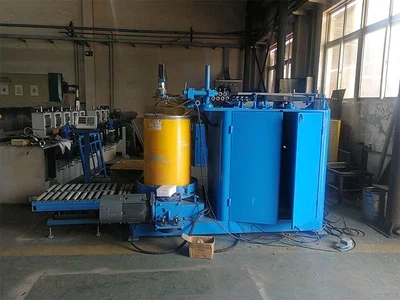
So, if you’re looking to take your production data collection and analysis to the next level, we’re here to help. Our other auxiliary equipment can make a big difference in your production process, from improving quality to saving costs. Don’t hesitate to reach out if you want to learn more about our products or have any questions. We’d love to have a chat with you and see how we can assist you in making your production more efficient and profitable.
Flux-Cored Wire Manufacturing Machine References
- Hayes, R. H., & Wheelwright, S. C. (1984). Restoring our Competitive Edge: Competing through Manufacturing. Wiley.
- Womack, J. P., Jones, D. T., & Roos, D. (1990). The Machine That Changed the World. Rawson Associates.
Three Water Machinery Co., Ltd.
Three Water Machinery Co., Ltd. is one of the most reliable manufacturers and suppliers of auxiliary equipment in China. With abundant experience, we warmly welcome you to buy advanced equipment for sale here and get quotation from our factory. Contact us for more details.
Address: No.15, Jiaye Road, Liuanzhuang Industrial Park, Beichen District, Tianjin, China
E-mail: sales@eqet.com
WebSite: https://www.eqet.com/
